
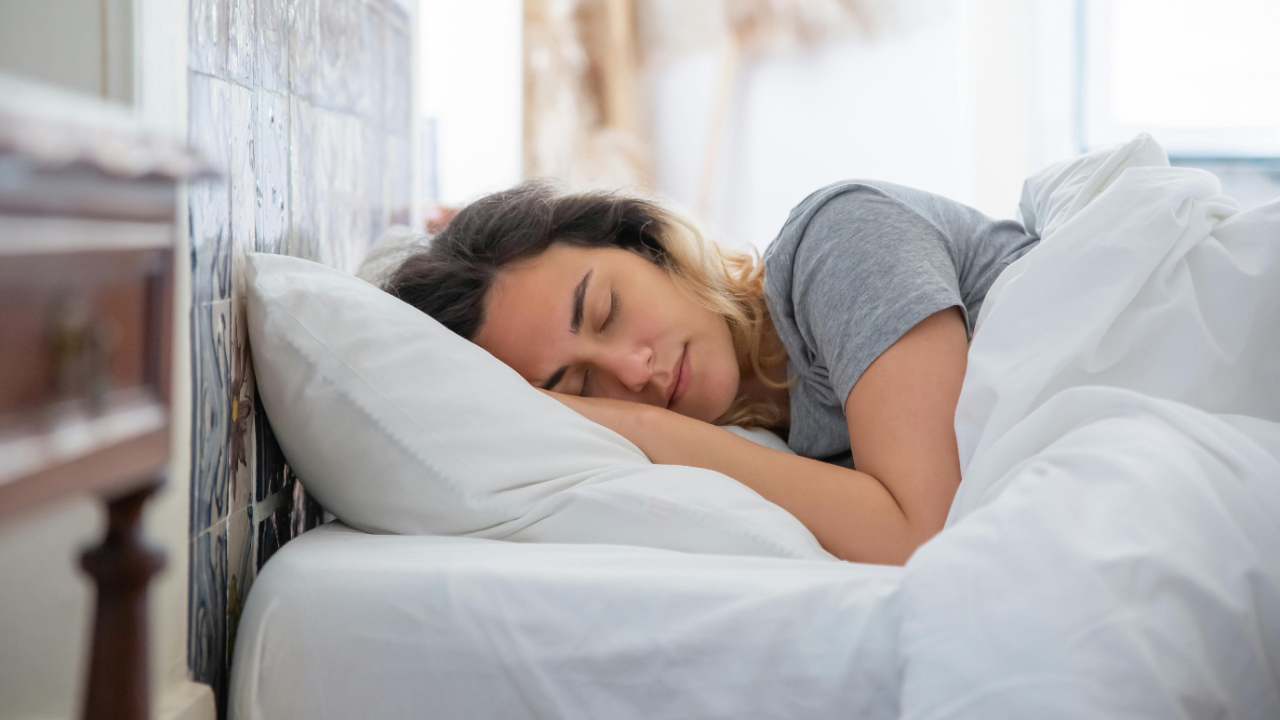
Sleep Anxiety? How to STOP Obsessing Over Sleep & Finally Fall Asleep Fast
Mar 13, 2026Do you constantly think about your sleep?
Analyzing it.
Tracking it.
Worrying about how many hours you’ll get.
Replaying how badly you slept last night.
If this sounds familiar, you’re likely dealing with sleep anxiety — and ironically, that anxiety may be the exact thing keeping you stuck in the insomnia cycle.
The more you try to control sleep… the more it slips away.
But here’s the good news:
You can break free from sleep anxiety with 4 simple shifts — and once you understand them, sleep starts to feel like no big deal again.
🎥 Watch this on YouTube (or keep reading below!)
What Is Sleep Anxiety?
Sleep anxiety is a hyper-focus on sleep.
It sounds like:
- "What if tonight is another bad night?"
- “If I don’t sleep well, tomorrow I’ll be exhausted.”
- "My heart is already racing just thinking about sleep."
- "I'm scared to even get into bed."
- "What if I lay awake all night again?"
This mental loop creates pressure.
And pressure activates your stress response.
When your stress response is activated, your body releases cortisol and adrenaline — which are the exact opposite of what your brain needs to fall asleep.
So ironically, the more you want to sleep… the more awake you become.
Why Obsessing Over Sleep Makes It Worse
Here’s what most people don’t realize:
Your subconscious mind may have started associating nighttime with stress instead of rest.
It often begins like this:
- You have one bad night of sleep.
- You worry about it happening again.
- That worry activates your survival response.
- Your brain links nighttime with stress.
- The cycle repeats.
Over time, your brain builds a habit of staying on high alert at night.
Not because your sleep is broken.
But because your survival brain thinks it’s protecting you.
It’s a miscommunication between:
- Your conscious mind (which wants sleep)
- Your subconscious mind (which thinks staying alert is safer)
The good news?
This pattern can be broken!
How to Stop Sleep Anxiety (4 Powerful Steps)
Here’s how to break the anxiety loop and finally let sleep happen naturally again.
✅ Step 1: Stop Measuring Your Sleep
If you:
- Count hours every night
- Track sleep on apps obsessively
- Check the clock repeatedly
- Analyze your “sleep score”
You may be reinforcing anxiety.
Every time you measure your sleep and label it as “bad,” you send your brain the message:
“Sleep is a problem.”
Instead, shift your goal.
The goal is not:
“I need to be in bed by 10pm or my life is ruined”
The goal is:
“Nighttime is a time for me to rest & relax.”
Let go of the numbers.
✅ Step 2: Redefine What “Good Sleep” Means
If your definition of good sleep is:
8 uninterrupted hours every single night
That’s an incredibly high bar.
Even great sleepers don’t sleep perfectly every night.
Try redefining good sleep as:
- Staying calm even if you woke up
- Resting your body, even if you weren’t fully asleep
- Not spiraling into panic at 2 AM
- Allowing imperfection
✅ Step 3: Practice Indifference
This might feel impossible at first.
But it’s powerful.
Indifference sounds like:
“Whether I sleep great tonight or not… I’ll be okay.”
That mindset tells your subconscious:
There is no emergency.
When you stop attaching your safety and happiness to one night of sleep, your nervous system relaxes.
And when your nervous system relaxes, melatonin can be released naturally.
Sleep is passive.
It happens when you stop chasing it.
✅ Step 4 (The Game-Changer): Take Your Attention OFF Sleep Entirely
This is my favorite step.
Sleep anxiety thrives on attention.
If sleep becomes the center of your life, your brain treats it like a high-stakes situation.
Instead, redirect your focus toward:
- Hobbies
- Passion projects
- Friendships
- Travel plans
- Things that excite you
Ask yourself:
- Am I in a job I dislike?
- Am I living in an environment that stresses me?
- Do I have goals I’m not pursuing?
- Do I have fun in my life?
For many people, improving alignment in life reduces sleep anxiety naturally.
When your life feels fulfilling, your nervous system softens.
And sleep returns on its own.
You Are Not Broken
Sleep anxiety does not mean:
- Your sleep is permanently damaged.
- You’ve lost the ability to sleep.
- You need to micromanage your evenings forever.
It means your brain learned a protective pattern.
And it can rebalance back into its natural state of calm evenings & restful sleep.
Free Masterclass: Retrain Your Brain to Sleep Naturally Again
If you want help retraining your mind and body to sleep naturally again, I highly recommend watching my free masterclass.

Inside, I share:
- The 3 biggest mistakes keeping you stuck in insomnia
- How to break the anxiety-sleep loop
- The exact strategy I teach my clients
- How to reprogram your subconscious for natural sleep
👉 Access the free masterclass here!
Final Thoughts
Sleep anxiety is fueled by pressure, perfectionism, and over-importance.
The moment you stop obsessing…
The moment you release control…
The moment you shift focus back to living your life…
Sleep becomes effortless again.
You still have the natural ability to sleep.
💙 For more sleep support, programs, and resources, visit my website:
Wishing you restful nights, and a beautiful day ahead 🌙✨
To better sleep,
Meredith Louden 😴
Founder of Sleep Success®
